0113 249 2222


Here at The Plastic People, we know quite a bit about different plastic materials, their uses, and their properties. Of all the plastics we work with daily, acrylic (also known as Perspex, Plexiglas, and PMMA) is one of our favourite materials, as it's simply so easy to use.
Although the best way to cut it is often through the process of Plexiglas routing (similar to routing acrylic), there are plenty of ways to cut it at home, which we’ll share with you today. Read on below to find out what acrylic and Perspex are, and how you can simply and easily cut them at home.
What is acrylic and Perspex?
Acrylic is a popular plastic. It’s lightweight, affordable, and shatterproof – the perfect DIY material for a range of home projects. Perspex is simply a brand name for a premium acrylic. It’s truly a wonder material, useful for so many jobs around the house.
Don’t have the tools to cut your acrylic and Perspex? No problem
If DIY isn’t your thing, or you’re looking for a more complex and intricate shape or design cut from acrylic, then get in touch with our team today. We cut acrylic – and a range of other plastics, including PVC and polycarbonate – to any size or shape, and deliver it straight to your door.
Cutting acrylic and Perspex with hand saw
Using a hand saw to cut your acrylic material is perhaps the most universal option – and it requires fairly little skill. This method does, however, demand more concentration and effort than using an electric saw, such as a jigsaw or band saw.
Tools you need:
- Fine-tooth hand saw or hack saw – a wood saw as this can damage the material
- Ruler and marker pen.
- Solid, flat cutting surface.
- Clamp (optional).
How to cut plastic with a hand saw:
- Begin by creating a guide for yourself directly on the plastic’s surface with a marker pen. Tip: straight lines will be the easiest to cut cleanly.
- Clamp your acrylic into place or weigh it down on one end to help stabilise the material.
- Begin cutting – try to keep the acrylic as still as possible to avoid warping your cutting path.
Scoring and breaking acrylic and Perspex
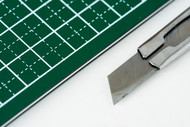
Scoring and breaking your acrylic or Perspex is a relatively quick and hassle-free way to cut plastic to the desired size. Note: this method should only be used on acrylic under 5mm.
Tools needed for scoring and breaking plastic:
- Ruler or straight edge and marker pen.
- Scoring knife.
- Solid, flat cutting surface.
- Clamp (optional).
How to score and break Perspex and acrylic:
- Begin by marking out the area you want to cut and then securing the acrylic sheet into place on your cutting surface.
- Next, using your ruler as a guide, run the scoring knife along the surface of the plastic a few times to create a narrow groove.
- Place the edge you wish to remove over the edge of your flat surface and, with a quick movement, push down on the overhanging edge (or waste plastic). The plastic will begin to bend and crack, leaving you with two sheets of acrylic.
Cutting plastic with a jigsaw
Using a jigsaw has the benefit of efficiency over our two previous options. It’s quicker to work with and thus requires less concentration. With an electric saw, you can also create more intricate cuts as it’s easier to manipulate your tool.
Tools you’ll need:
- Jigsaw with a fine-tooth blade.
- Ruler or straight edge and marker pen.
- Safety glasses.
- Flat work surface.
- Clamp (optional).
How to cut acrylic and Perspex with a jigsaw:
- Begin by creating a guide on the surface of the acrylic. You can cut a straight edge with a jigsaw, or opt for a more freehand curve if you want to create a circular piece of plastic.
- Clamp into the place and put on your safety goggles in case any plastic particles are dislodged during the cutting process. Clamping will prevent the plastic from vibrating and moving around.
- Saw through the plastic. When using electric saws, it’s best to work quickly as they create extra heat that could bend/warp the acrylic plastic.
Cutting Perspex and acrylic with a bandsaw
Band saws are typically quite large pieces of machinery that you will only find in workshops and on factory floors. For instance, we use some form of the bandsaw to prepare and cut all our acrylic sheets here in The Plastic People factory.
Tools you need:
- Bandsaw.
- Marker Pen.
- Safety Goggles.
How to cut acrylic and Perspex sheets with a bandsaw:
- Begin by marking your plastic. Some high-tech band saws come with guides built into the machine, so you may be able to avoid this step.
- With your safety goggles on, turn on the bandsaw and begin passing the plastic through the blade.
Tip: there is a range of different blade widths for band saws – and the one you choose depends on the plastic thickness and desired shape. Do your research or check the manufacturer’s guide before beginning.
Laser cutting plastic sheets
This final method for cutting plastic is reserved primarily for intricate shapes and complex designs that need to be machined precisely. Laser cutters use a CAD programme where the dimensions/design is entered into a computer that operates the laser cutter or CNC router.
At The Plastic People, we use laser cutters and CNC routing/milling machines for our Plexiglass routing as well as other routing processes to create complex parts, components and products - to extremely tight tolerances – for a wide range of different businesses and industries. Click here to find out more and enquire about our services.
Finishing process for cut plastic
Once you have cut your Perspex sheet or panel to the desired size and shape, you may notice a rough or jagged edge. The surface of the acrylic may also have become dusty, scratched or dirty.
To sand rough edges, you can use sandpaper (typically 600-1000 grit), a metal file or an electric sander or buffing machine. Begin by filing down rough edges, before sanding the acrylic. Every few minutes, you should wipe down the edge as well to remove any debris.
For more in-depth advice on finishing acrylic sheets, cleaning acrylic, removing scratches from the surface of your plastic and more, see our full list of blogs and articles.
Get more help on cutting Perspex and acrylic sheets
Our team of plastic experts are always on hand to help you with your projects. If you need further advice on working with acrylic – or any plastic material for that matter – get in touch today.